
Lichfield District Council has £1,172,367 for community groups, in annual grants of £1,000 to £50,000. Applications close at 5pm on Thursday 10 September 2026.
Voluntary and community groups across Lichfield district have until 5pm on Thursday 10 September to bid for a share of £1,172,367, the largest pot Lichfield District Council has put in front of the sector. The window opened on 30 July and closes in just over three weeks.
One detail in the council’s own announcement is worth correcting before any group starts writing. The press release describes the money as available “over the next three years”, but the funding prospectus is specific: awards cover April 2027 to March 2030, and successful projects start in April 2027. A group with a cash gap this winter will not be filled by this fund.
How the £1,172,367 splits
The total is divided in two, and the split matters because the smaller pot is far easier to win a large share of:
- £672,367 for general projects, in annual awards of £1,000 to £50,000. The prospectus says the council is “unlikely to award more than £50,000 per year to any one organisation” so that it can support as many groups as possible.
- £500,000 ring-fenced for community transport, in annual awards of £1,000 to £25,000 per organisation.
That £500,000 is new, and it is 43% of everything on the table. The council says the programme includes a dedicated community transport fund “for the first time”. It covers not-for-profit, community-led or volunteer-supported transport where public or commercial services are limited or unsuitable: volunteer driver schemes, community minibuses, dial-a-ride and door-to-door services, transport to medical appointments or hospital discharge, wheels-to-work schemes, community car shares, and booking systems that make existing transport easier to use.
For the villages, that is the practical opening. The prospectus asks explicitly for projects that “support rural communities or areas with limited public transport provision”, and applicants must show their scheme complements rather than duplicates what already runs. Anyone in Alrewas, Elford, Hints or Kings Bromley who has tried to reach an appointment without a car will recognise the gap; our Lichfield train and travel page covers what the scheduled network actually offers.
Every applicant must find 10% themselves
The requirement that catches small groups out is match funding. A minimum of 10% of project costs must come from somewhere other than this grant. It does not have to be cash: volunteer time, donated resources and free use of a venue all count, and if you count volunteer hours the application must state the hourly rate used.
Grants are paid quarterly in arrears, after a payment request form and monitoring information have been submitted, and the council has to be satisfied the project is on track before releasing the next instalment. A group without working capital needs to plan for that.
What the council will not fund
The exclusions are unusually specific, and several rule out the kind of bid community groups most often submit:
- Any school curriculum-based activity.
- Anything for the sole benefit of an individual.
- Events whose principal aim is raising funds for another organisation.
- Political or religious activities, though secular activities run by faith-based groups are welcome.
- Projects entirely subcontracted to another party.
- Statutory duties of public bodies, unless the project enhances existing delivery.
- Anything already delivered. Applications cannot be made in retrospect.
- Projects outside the district boundary, unless they benefit district residents.
Organisations that cannot evidence a governance and policy framework are excluded outright, and the document list is not a formality. Applicants must be able to supply a constitution, latest annual report and accounts (or six months of financial statements for a new organisation), a health and safety policy, an equalities and diversity policy, public liability insurance certification, and children’s and adult safeguarding policies where relevant. Each must have been written or reviewed within the last three years. The prospectus states twice that applications failing these requirements “will not be assessed”.
The bar the panel is scoring against
Bids are marked by a panel of officers against strategic fit, evidence of need, deliverability, value for money and sustainability, then moderated before recommendations go to a member panel. Projects must support at least one of the four outcomes in the council’s Lichfield District 2050 strategy: confident, prosperous, active and green communities.
The active strand comes with a number that explains why the council is asking for it. The prospectus records that around 38% of adults and 60% of children and young people in the district are not active at recommended weekly levels.
The council also wants applicants to show what happens when the grant stops. Seven assessment criteria run through collaboration with other partners, evidence of need in a specific group or locality, reducing long-term reliance on public sector support, and leaving “a sustainable positive legacy beyond the period of Council funding”. Groups may be asked for risk registers, performance targets, an exit plan, quarterly reports, or to present to the assessment panel in person.
What the last round paid for
This programme replaces one worth £787,288, which funded 14 organisations. The council says that over the past two years those groups recruited more than 200 new volunteers, gave support or guidance in more than 3,000 cases, improved the mental health and wellbeing of more than 3,300 young people, and helped more than 300 adults improve their wellbeing.
At £1,172,367, the new programme is £385,079 larger, a rise of 49%. Councillor Richard Cox, cabinet member for community and public protection, said the council was making its biggest-ever investment in the sector “because we know that by working together we can achieve even more for residents across Lichfield District”.
Continued funding across the three years is not guaranteed. The prospectus warns that if impact is not evidenced, and other projects better meet local needs, “funding may be reallocated”.
The dates that matter
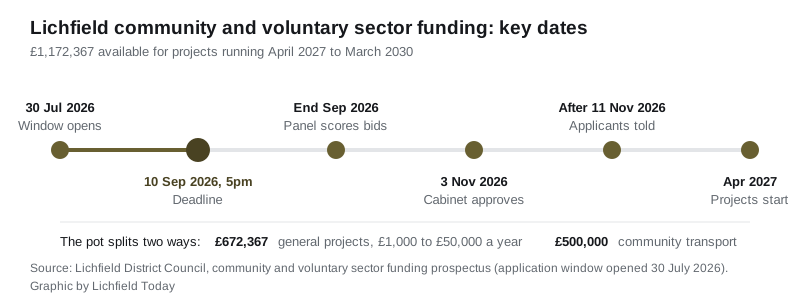
Applications are scored by the end of September. Cabinet approves the allocations on 3 November 2026, and successful and unsuccessful applicants are told by email after 11 November, once the five-day call-in period following the cabinet decision has passed. Unsuccessful applicants can request feedback. The council’s decision is final.
What it means for you
If you run a constituted not-for-profit group serving the district, a locally based community enterprise or a charity, you have until 5pm on Thursday 10 September. The route in is not an open online form: read the prospectus, then email CVS@lichfielddc.gov.uk to check your eligibility and request the application form, which is completed through Microsoft Forms. Late applications may not be considered, so leaving the eligibility email until September is a risk.
Partnership bids from two or more organisations are allowed and are actively encouraged, provided one lead partner is identified. Collaboration is one of the seven scored criteria, so a joint bid from two village groups may score better than either alone.
If you need less than £1,000, this is the wrong fund. The council points smaller applicants to the We Love Lichfield Fund, the Lichfield Community Lottery and Staffordshire Commissioner community funding, and suggests Support Staffordshire or the Community Foundation for Staffordshire for advice.
And if you are simply looking for what is already running in the district rather than money to run something new, our guide to things to do in Lichfield lists what is open now.
Have your say