
Ofsted rated The Bridge Academy at the expected standard in all six areas, with safeguarding met, at the Lichfield school that takes excluded pupils.
Ofsted has published its report on The Bridge Academy on Wissage Road, and the school comes out at the expected standard in all six areas inspectors grade. Safeguarding standards are met.
It is an academy alternative provision for pupils aged 5 to 16 who have social, emotional or mental health difficulties, or who have been excluded from their previous school. Almost every pupil is placed there by Staffordshire County Council.
The inspection report covers a visit on 14 July and was published on 11 September. The lead inspector was Antony Bradshaw, His Majesty’s Inspector, working with team inspector Chris Pollitt.
What inspectors wrote about the pupils
The report’s plain-English section is unusually direct. Inspectors wrote that The Bridge Academy “is where pupils find their way back to education and rediscover who they are”, and that pupils “arrive unsure whether school is a place where they can belong or succeed”.
Their closing line is the one that will travel: the school “offers stability, hope and the belief that their future can be brighter than their past”.
On achievement, inspectors said progress here is not only about grades. Pupils “make progress across the curriculum and enjoy practical subjects most”, learning to cook and becoming “successful artists”, with improvements particularly in reading and mathematics. Achievement, the report says, “is reflected not only in qualifications but also in pupils’ renewed engagement with education, improved attendance and greater readiness for future learning”.
The grades, and what “expected standard” actually means
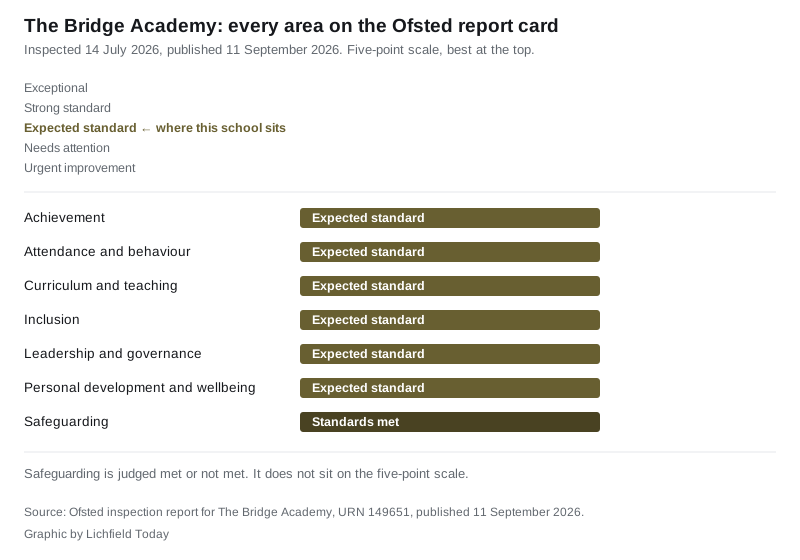
This is the new Ofsted report card, and it is worth knowing how to read it before you judge the result. Single-word verdicts are gone. Each area is graded on a five-point scale, which Ofsted defines in the report itself:
- Exceptional: “of the highest standard nationally. Other schools can learn from it.”
- Strong standard: “Leaders are working above the standard expected of them.”
- Expected standard: “the school is fulfilling the expected standard of education and/or care.”
- Needs attention: standards not met, but leaders are likely able to put it right.
- Urgent improvement: urgent improvements needed.
Safeguarding sits outside that scale and is judged met or not met. At The Bridge Academy it is met, which Ofsted says means leaders “have established an open culture in which safeguarding is everyone’s responsibility”.
So “expected standard” across the board is not a middling result dressed up. It is the bar, and this school is over it in every area an inspector looked at.
The numbers behind the school
The data Ofsted used on inspection shows what the staff are working with:
| Measure | The Bridge Academy |
|---|---|
| Total pupils | 54 |
| Eligible for free school meals | 66.7% |
| With an education, health and care plan | 18.52% |
| On SEN support | 81.48% |
| Overall absence, 2024/25 | 25.6% |
| Persistent absence, 2024/25 | 76.2% |
Those absence figures need context rather than alarm. Pupils arrive at an alternative provision having already stopped attending somewhere else. Inspectors said leaders “understand that many pupils join the school with significant barriers to regular attendance, including exclusion, anxiety and negative perceptions of school”, and that “many pupils improve their attendance over time”. Overall absence fell from 30.2% in 2023/24 to 25.6% in 2024/25.
Four pupils are dual registered, sharing their registration with a mainstream school for a short period. The school itself uses three other alternative provisions.
What Ofsted told the school to do next
Inspectors set three next steps:
- develop pupils’ communication, language and writing so they can “express their ideas, explain their thinking and communicate their learning confidently across the curriculum”
- strengthen the use of assessment so gaps in learning, including those caused by absence, are “identified and addressed consistently”
- strengthen the evaluation of additional funding and targeted support so the impact “can be demonstrated with greater precision”
The third is the sharpest. Inspectors found leaders use extra funding to provide targeted support “appropriately”, but “do not consistently evaluate impact, limiting the effectiveness of some interventions”.
Who runs it
The Bridge Academy joined the Arthur Terry Learning Partnership in September 2024, having previously operated as an alternative provision outside a trust. The head of school is Elliot Payne. The trust is run by acting chief executive Lee Miller and overseen by trustees chaired by Helen Stevenson.
Inspectors said trustees “provide appropriate support and challenge” and understand the context of the provision.
What it means for you
If your child is at risk of permanent exclusion, or has stopped attending, this is one of the settings Staffordshire County Council can place them in, and you now have a current, independent account of what it is like inside. The full report is free to read on Ofsted’s site and runs to a few pages.
If you are reading other schools’ reports in the district, expect the same five-point scale. Ofsted’s renewed framework replaced the old single-word verdicts, and this report is one of the new ones. A school graded “expected standard” has not been marked down from “good”: that word is not on the scale any more.
You can look up any school’s current report on the Ofsted reports service, and check what is being built or changed nearby on our Lichfield planning news page.
Have your say