
Lichfield Cathedral School reported 53% of grades at A* or A and King Edward VI 50% at A*-B, against 24.2% at A or above across the West Midlands. School by school, with the figures each one published.
Sixth formers across Lichfield and Burntwood collected A-level, BTEC and Cambridge National results this morning, and two of the district’s four sixth forms put hard grade percentages into the public domain. Lichfield Cathedral School reported that 53% of its grades were A* or A. King Edward VI School reported an average grade of B across 25 subjects, with half of all grades at A*-B.
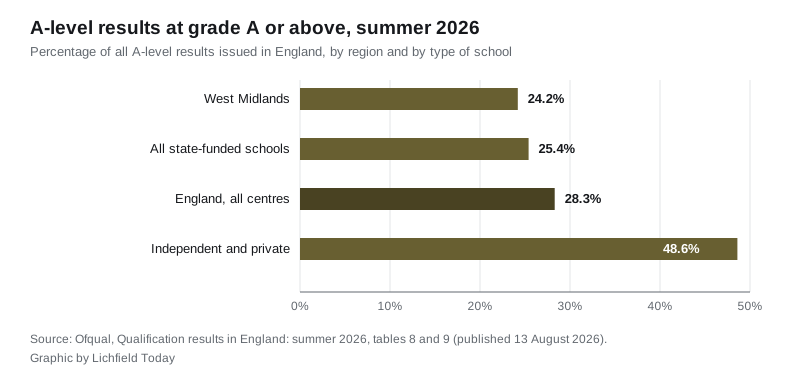
Those figures land against a national picture published the same day. Ofqual’s own summer 2026 release shows that 24.2% of the 81,530 A-level results issued in the West Midlands were graded A or above, and 74.6% reached grade C or above. Across England, 28.3% of 835,950 results were A or above. The regional A-grade share has not moved at all since 2025, when it was also 24.2%, though the proportion at C and above nudged up from 74.2%.
Lichfield Cathedral School: 53% at A* or A
The independent school on The Close published the fullest set of numbers of any sixth form in the district: 53% of grades at A* or A, 71% at A*-B, 98% at A*-C, and a maintained 100% pass rate. It also reported that 86% of BTEC grades were Distinction* or Distinction.
That 53% sits above the 48.6% of A-level results graded A or above across independent and private schools in England this summer, which is the fair comparison for a fee-paying school rather than the 28.3% England-wide figure.
Headteacher Sue Hannam made a point of the school’s intake. “As a non-selective school, students start Sixth Form with a wide variety of GCSE results, yet they have far exceeded all predictions,” she said. “The difference Lichfield Cathedral School has made to their education demonstrates why we are consistently placed in the Top 10% of schools nationally for value-added.”
Leavers are going on to law, business, psychology, biomedical sciences, criminology, philosophy, history and maths degrees, and to degree apprenticeships including one in engineering with Airbus.
King Edward VI School: average grade B, half of grades at A*-B
King Edward VI School, the state academy on Upper St John Street, reported an average grade of B across 25 subjects, with 50% of grades awarded at A*-B. The school said more than 80% of entries reached A*-C, and that 45% of students taking BTEC and Cambridge National programmes achieved a Distinction*.
KES did not publish a figure for grades at A* or A, so its results cannot be set directly against the Ofqual regional and national numbers, which are measured that way.
Headteacher Catharine Forster said the grades were “the culmination of hard work from students alongside the support of parents and teachers”, and added that “these results are only part of the story: the students have been an incredible year group who have contributed to the school in many ways and been role models for our younger students”. Students are progressing to courses including medicine and engineering, some at Cambridge, as well as to apprenticeships and employment.
The Friary School: destinations, not percentages
The Friary School reported that the overwhelming majority of its students secured places at their first-choice universities, including on medicine and law courses, and named ten students who achieved three or more A* grades. It published no overall grade percentages.
Its apprenticeship figures are the more unusual part of the statement. Friary students took up places in engineering, legal, surveying, auditing and accounting roles and in the civil service, and the school’s careers programme has been rated exemplary by the Careers & Enterprise Company.
Head of Sixth Form Andrea Garner-Thorpe said the school was “very pleased to see others secured highly competitive apprenticeship opportunities, including several very prestigious degree apprenticeships”. Headteacher Mark Drury said the year group had “raised thousands of pounds for local charities, volunteering in the community”.
Chase Terrace Academy: a results day with Ofqual in the room
Burntwood’s Chase Terrace Academy did not publish grade percentages either, but it had a results day nobody else in the district had: the exams regulator Ofqual sent a team to the school to spend results morning with students, families and staff, and recorded a podcast with Mike Donoghue OBE, chief executive of the John Taylor Multi Academy Trust.
The school listed destinations including cyber security at Portsmouth, earth sciences at Aberystwyth, chemistry at St Andrews, history at Exeter, and forensic science and criminal investigation at the University of Central Lancashire, alongside apprenticeships in pharmacy, the Royal Air Force and commercial aviation.
Head of Sixth Form Richard Giles said it had been “a privilege to watch them grow during their time in Sixth Form”, and asked leavers to “keep in touch and visit us when you return to Burntwood”.
The comparison nobody can make for you
Only Lichfield Cathedral School published a figure measured the same way as the national statistics, which is the honest limit on any local league table this week. The other three sixth forms reported a mixture of A*-B shares, average grades and destination lists, and those cannot be lined up against each other or against Ofqual’s A-and-above percentages without comparing different things.
It is also worth knowing what the regional figure hides. Ofqual’s breakdown by centre type shows 48.6% of results at A or above in independent and private schools, 43.4% in grammar schools, 25.4% across all state-funded centres, 23.5% in academies and 12.8% in further education establishments. A school’s grade profile tracks the kind of school it is at least as much as it tracks the year group in it.
What it means for you
If your household is holding a results slip today, three practical points.
Clearing is open until 19 October and it is not a consolation prize. UCAS runs Clearing from 2 July to 19 October 2026, and it is open to anyone not holding an offer, anyone who missed the conditions of an offer, anyone who applied after 30 June, and anyone who has used the “decline my place” button to give up a firm place. Unplaced applicants get a “My matches” button in their application showing their top 50 course matches.
A review of marking has to be asked for by the school, and the grade can fall. Ofqual’s rules are that most awarding organisations do not accept requests directly from students, so the first call is to the sixth form, which can order a copy of the marked paper through Access to Scripts before deciding. A fee may be charged, and if an error is found the mark can go down as well as up.
A missed prediction is not evidence of a marking error. Ofqual states plainly that no awarding organisation can add marks because a result sat close to a grade boundary or fell short of a prediction, and that in most years only around 20% of students accepted to university meet or exceed their predicted grades.
Anyone weighing up staying in the district for sixth form has an open evening date already in the diary: King Edward VI School holds its sixth form open evening on Wednesday 4 November 2026, from 6pm to 8pm.
GCSE results follow on Thursday 20 August 2026, the date Ofqual has set. We will cover those the same way, from what each school publishes itself.
Have your say