
Lichfield's claimant count rose to 1,595 in September, up 11.9% in a year, the fastest rise in Staffordshire. Under-25s hit 380, the most since 2021.
The number of people claiming unemployment-related benefits in Lichfield district rose to 1,595 in September. That is 170 more than a year ago, a rise of 11.9%, and the steepest annual increase of any of Staffordshire’s eight districts.
The count has not been this high since August 2024. Claimants aged 16 to 24 rose again, to 380, the most for that age group since July 2021.
The figures come from the ONS claimant count, published through nomis on 20 October. For Lichfield district in September 2026:
- 1,595 people claiming, 2.4% of residents aged 16 to 64
- up 65 on August’s revised 1,530, a rise of 4.2%
- up 170 on September 2025, when the count was 1,425
- 380 claimants aged 16 to 24, 840 aged 25 to 49 and 380 aged 50 and over
The age bands are rounded separately by the ONS, so they add up to 1,600 rather than 1,595.
Lichfield is still not a high-unemployment district. Its 2.4% rate is the second lowest in Staffordshire, below the county’s 2.8%, the United Kingdom’s 3.9% and England’s 4.1%. What has changed is the direction, for a second month running.
September normally brings the number down
In most years the Lichfield count falls or holds still between August and September. It fell in nine of the thirteen years from 2013 to 2025 and was flat in two. It rose only in 2016, by 45, and in 2018, by 35.
This year it rose by 65. That is the biggest August to September increase in the fourteen years of monthly figures nomis holds for the district.
| Year | August | September | Change |
|---|---|---|---|
| 2022 | 1,560 | 1,490 | -70 |
| 2023 | 1,470 | 1,470 | 0 |
| 2024 | 1,620 | 1,595 | -25 |
| 2025 | 1,455 | 1,425 | -30 |
| 2026 | 1,530 | 1,595 | +65 |
The month-to-month movements are comparable across those years. The levels before about 2018 are not, because Universal Credit brought people into the count who are working on low earnings and still required to look for more work.
Under-25s are still the group that is moving
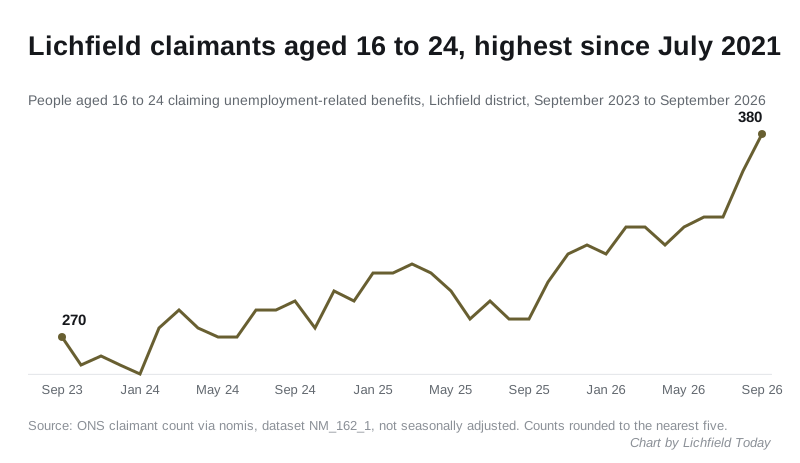
There were 380 claimants aged 16 to 24 in September. That is up 20 on August and up 100 on September 2025, when there were 280, a rise of 36% in a year. The last time the figure was higher was July 2021, at 390, as the labour market came out of the pandemic (nomis, 16 to 24 series).
Three years ago the number was 270. It drifted between 250 and 310 until the end of 2025 and has climbed almost every month since.
The other age groups grew more slowly over the year:
- 25 to 49: 840, up 55 on September 2025, a rise of 7%
- 50 and over: 380, up 20 on September 2025, a rise of 6%
Under-25s are now almost a quarter of all claimants in the district. The ONS does not publish a claimant rate for single age bands, so there is no official under-25 percentage to set against the 2.4% headline.
How Lichfield compares with the rest of Staffordshire
Six of the eight districts rose over the year. Stafford added slightly more claimants in number, 175 against Lichfield’s 170, but from a bigger base. As a share of its own count, Lichfield’s rise was the largest in the county.
| District | Claimants | Rate | Change on Sept 2025 |
|---|---|---|---|
| Lichfield | 1,595 | 2.4% | +170 (+11.9%) |
| South Staffordshire | 1,775 | 2.7% | +155 (+9.6%) |
| Stafford | 2,185 | 2.6% | +175 (+8.7%) |
| Cannock Chase | 2,055 | 3.2% | +145 (+7.6%) |
| Tamworth | 1,665 | 3.3% | +90 (+5.7%) |
| Staffordshire Moorlands | 1,230 | 2.2% | +50 (+4.2%) |
| Newcastle-under-Lyme | 2,380 | 3.0% | +25 (+1.1%) |
| East Staffordshire | 2,540 | 3.2% | -170 (-6.3%) |
Source: nomis, all Staffordshire districts and rates. Rates are the share of residents aged 16 to 64. Counts are rounded by the ONS to the nearest five.
On the month, Tamworth rose most, by 70. Lichfield’s 65 was next. East Staffordshire was the only district where the count fell between August and September.
August has been revised down
Last month we reported that the count had jumped 95 to 1,565 in August. The ONS has since revised August to 1,530, so the July to August rise was 60, not 95. The under-25 figure for August moved from 365 to 360.
That is how the series works. The ONS quality report says the Universal Credit part of the count allows revisions to the previous month. Every Staffordshire district’s August figure came down this time. September’s 1,595 could move in the same way when the October data comes out. Our August story now carries a note saying so.
Even on the revised figures, the count rose by 125 between July and September. That is the biggest rise over those two months in the series, ahead of 65 in 2016. Over the same two months it fell in 2022, 2023 and 2025, and rose by just 5 in 2024.
What the claimant count is, and is not
It is not the unemployment rate. The ONS counts people claiming benefits mainly because they are unemployed. Since Universal Credit, that includes people in work whose earnings are low enough that they must look for more. A rise can mean fewer jobs, fewer hours, or more people being asked to search.
What it means for you
If your income has fallen, the district council handles help with council tax, not the DWP. Lichfield District Council runs council tax support, and its benefits section has a benefits calculator, the Crisis and Resilience Fund and a referral to Citizens Advice. Council tax support cuts the bill without changing your band; our page on what the bands cost in Lichfield shows the full charges.
If you are 16 to 24 and looking for work, the numbers say you are not imagining it. Your age group has grown by more than a third in a year, while the district’s headline rate still looks low.
The October figures are due from the ONS in mid November. We will report them, and any revision to September, when they appear.
Sources
- ONS claimant count, Lichfield district, 25-month series, dataset NM_162_1, not seasonally adjusted, updated 20 October 2026
- ONS claimant count, Lichfield district, aged 16 to 24
- ONS claimant count, Staffordshire districts
- ONS Claimant Count Quality and Methodology Information
- Lichfield District Council benefits and money advice
Have your say