
Lichfield District Council asks which services to protect or cut in 2027/28, by 18 November. It keeps £3.88 a week of a typical bill; 1,374 people replied last year.
Lichfield District Council wants to know which of its services you would protect, expand or cut next year. Its annual budget consultation opened on 7 October and closes on Wednesday 18 November.
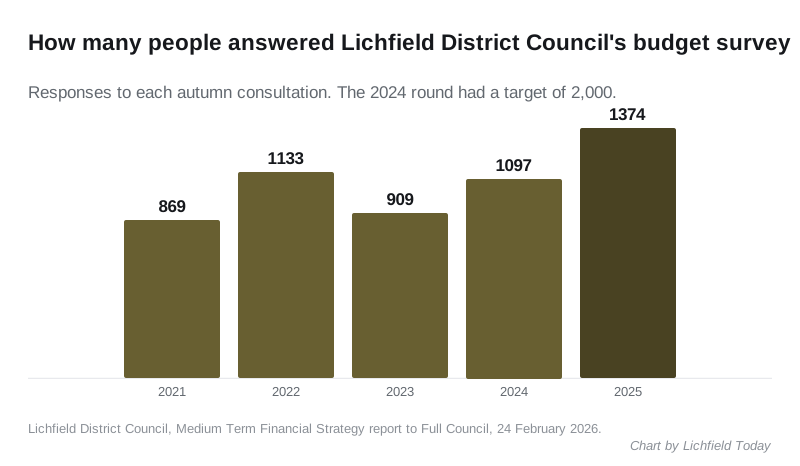
The answers feed into the 2027/28 budget, which councillors will vote on in February. Last year’s round drew 1,374 responses, the most in the five years for which the council publishes a count. When the 2026/27 budget was agreed in February, the council said it had been “shaped following feedback from residents” through that survey.
What you are being asked
The consultation page groups the council’s 60-plus services into nine areas and asks five things:
- Which council services matter most to you?
- Where should spending be reduced, protected or increased?
- What increase in the council’s share of council tax, if any, would you accept?
- Do the services give value for money?
- How could the council manage its budget or deliver services differently?
The nine service areas are waste and recycling, parks and open spaces, leisure and wellbeing, housing and homelessness, planning and development, environmental protection, community safety, regeneration and the local economy, and arts, events, heritage and tourism.
You can answer online through the consultation page, ask for a paper copy on 01543 308000, or collect one from District Council House on Frog Lane. There is a separate version for under-18s, aimed at schools, colleges and youth groups.
How much of your bill this is about
The district council collects the whole council tax bill but keeps about 9% of it. The rest goes to Staffordshire County Council, the police and fire commissioner and your parish council. The council puts its own share at around £3.88 a week for an average household.
In cash terms, the district’s band D charge for 2026/27 is £201.79, up £3.94 or 1.99% on the year before. Our council tax bands page shows the full split for every parish. The council’s net spending on services this year, after income, is about £16.1 million.
Councillor Rob Strachan, cabinet member for finance and commissioning, said the cost of delivering services “continuing to rise” made it “more important than ever that we understand what matters most to our residents”.
What last year’s respondents said
The council published a summary of the 2025 survey in the budget report that went to Full Council on 24 February. Among the 1,374 responses:
- 98% came from residents, and every ward was represented
- 43.4% of respondents were aged 65 or over
- 72.0% supported some level of council tax increase
- 43.9% rated value for money as good or extremely good; 14.6% said poor or very poor
- average satisfaction with council services was 3.65 out of 5
- the services most often ranked high priority were waste and recycling, parks, leisure and wellbeing, community safety and environmental protection
A total of 568 people added written comments. The report lists the recurring themes as calls for transparency, efficiency and value for money, mixed views on non-statutory services, and support for preventative and community-based work. Scrutiny councillors asked that future surveys split the over-65 group into age bands so the council can see who is answering.
The money behind the questions
The same February report sets out the council’s forward position. It projected no funding gap in 2026/27 or 2027/28, then a gap of £657,000 in 2028/29 and £2.078 million in 2029/30. General reserves were expected to stand at £5.169 million at the end of 2026/27, against a minimum the council has set itself of £2 million.
Those projections were written when the district council was due to be abolished in 2028 under local government reorganisation. That timetable has since been paused by the government, so the 2027/28 budget is being set by a council that no longer knows when, or whether, it will hand over to a successor.
What it means for you
- If you use a service you fear losing, this is the formal route to say so. The survey asks you to name what should be protected, not just what should go.
- The council tax question matters. Last year 72% of respondents backed some rise, and the council then raised its share by 1.99%. Your answer this year is on record before councillors vote.
- Deadline: 18 November. The draft budget goes to Cabinet and Full Council in early 2027, and the final budget and an easy-read summary are published after that.
The county council, which takes nearly 72p of every pound on the bill, runs its own budget process separately. Check our council tax bands page for what each authority charges.
Have your say